Task Debrief and Completion
Core Process
About Debrief and Completion
Task debrief and completion is the process used to enter parts, labor, and other information on tasks and then complete the tasks and ultimately the service request.
Task Debrief and Completion Process Description
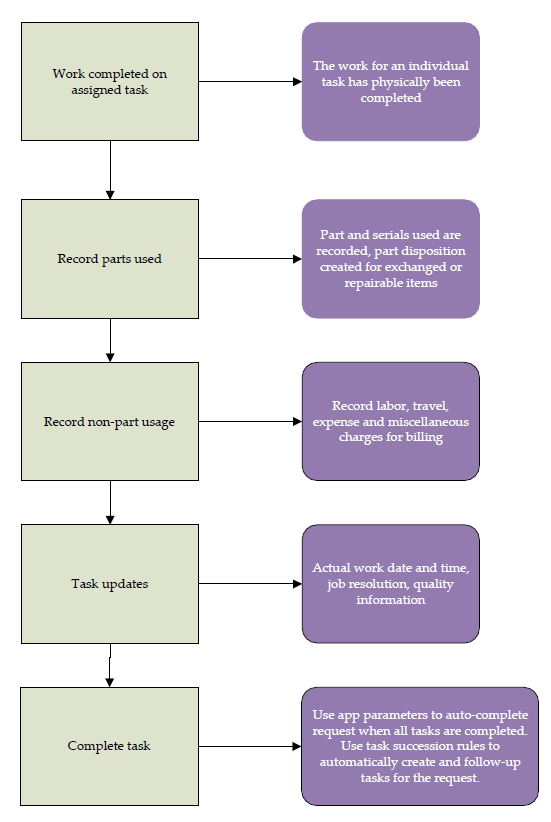
Task Debrief and Completion Process Details
- Review the assigned task.
- Begin performing the assigned work.
- If you need parts that you do not have, enter part needs.
- Complete the assigned work.
- Debrief the task:
- Complete all required steps
- Enter part usage
- Enter part dispositions
- Enter labor and expenses (non‐part usage)
- Record required meter readings
- Complete the task.
- Complete the request.
About Debrief
As you perform the assigned work, you record certain information, usually for inventory and billing purposes. Typically, you record the parts you used and the time you spent performing the assigned work.
Debrief can be performed at any time before task completion, depending on your organization’s procedures and the assigned work to be performed.
You can use the IFS Field Service Management (FSM) desktop client to perform debrief. You can also use a Technician Portal or handheld device with an FSM mobile application to perform debrief.
Part Disposition
When you perform service and remove a part, if it is a controlled part, you are prompted to enter a part disposition. For example, government regulations may require that the part be disposed of a certain way. Or, the part may have a high salvage value, for example it can be refurbished and sold again.
New Products
For parts where the part‐to‐product indicator is set and the part is installed, a new Product record is created for that part.
About Completion
The simplest form of completion is changing the task status to Complete.
Based on business rules and application parameters, the following may occur as well.
- When task succession rules are set up, completing a task may create a new task.
- When application parameters are set up, completing all tasks related to a request can also complete the request.
- When application parameters are set up, completing a request can also complete all tasks related to the request.